Grand Canyon - Things to Do in Grand Canyon in December

Things to Do in Grand Canyon in December

December weather, activities, events & insider tips

Low Season · Budget Friendly

December Weather in Grand Canyon

Temperature, rainfall and humidity at a glance

30 High Temp
24 Low Temp
0.4 inches Rainfall
70% Humidity

Is December Right for You?

Weigh the advantages and considerations before booking

Advantages
  • + December drops the South Rim's crowds to their annual floor. Mather Point, packed shoulder-to-shoulder in July, becomes a place where you might stand at sunrise with the 1,600m (1-mile) drop to the Colorado River almost entirely to yourself. The canyon's scale becomes comprehensible in a way it simply can't be when thousands of visitors share the same quarter-mile of rim. That silence at dawn, the cold air, the light beginning to move across the Redwall Limestone below, is something the canyon's summer version rarely offers.
  • + 3-5 cm (1-2 inches) of snow turns the canyon into something most visitors never witness. That thin white layer on Kaibab limestone against the deep red Supai Formation below creates a contrast photographers book winter trips to shoot. After a storm, the rim quiets in a specific way, your boots crunch frozen snow, wind drops in the gorge, nothing else. This is not the canyon from postcards.
  • + Hermit Road, the 12 km (7.5 mile) scenic drive along the West Rim, flips back to private wheels around November 1 and stays open through early March. April through October? Shuttles only. December means you drive yourself, brake at Pima Point when the low winter sun knifes into the gorge just right, and linger as long as you want. On still December mornings at Pima Point, the Colorado River's distant growl sometimes drifts up from 900m (3,000 ft) below, a low, continuous roar that no summer shuttle timetable ever leaves room to hear.
  • + December air is brutal and crystal-clear. The canyon finally shows its bones. Summer heat warps the inner gorge into a watery blur, limestone bands melt together, distance collapses. December strips that away. The dry desert sky pulls your eyesight across 300 km (190 miles) straight to the Kaibab Plateau. Suddenly you can read each limestone layer like pages in a book. Geologists call this a teaching moment. Photographers call it December light.
Considerations
  • The North Rim shuts mid-November and won't reopen until mid-May. December won't change that. The drive from South Rim to North Rim is 563 km (350 miles) around the canyon, a multi-day detour most visitors can't absorb on a typical December trip. Everything you'll see comes from the South Rim. It is magnificent. Expectations of experiencing both rims in one visit need adjusting before you book.
  • Ice on the upper trail sections is real, not a footnote. The switchbacks on Bright Angel Trail between the rim and the 1.5 Mile Resthouse freeze after overnight temperatures drop below -7°C (19°F), and they stay icy into the afternoon on cold days. Rangers loan traction devices at the trailhead. But the supply runs out. Visitors who arrive in sneakers expecting a canyon hike end up doing a rim walk instead, fine, but not what they came for.
  • December's daylight window is narrow, brutal. Sunset slams down at 5:15 PM. Sunrise won't show until nearly 7:30 AM. Below the rim, canyon walls kill direct light even sooner. Any hiking plan that ignores the 9-hour usable day ends with someone stumbling out in cold dark, manageable with a headlamp, yes, but demanding preparation that summer visitors never need consider.

Best Activities in December

Top things to do during your visit

South Rim Sunrise Photography

December's sun hangs low, only 25 degrees above the horizon at midday. The Redwall Limestone and Supai Formation catch this raking light, a phenomenon summer's overhead rays can't touch. Reds deepen. Oranges ignite. Across the canyon, north-facing cliffs stay locked in cool blue shadow. Landscape photographers plan entire winter trips for this contrast. December brings quiet rim viewpoints where you won't jostle for tripod space. The paved Rim Trail stretch between Mather Point and Yavapai Point, 2 km (1.2 miles), stays well-maintained. Most December mornings it's ice-free. Yavapai Geology Museum perches right on the rim with floor-to-ceiling windows. Opens 8 AM. When the cold bites, duck inside for warmth. Guided photography tours with canyon permits exist. Check current options in the booking section below.

Booking Tip: Book photography tours 2-3 weeks out, even low season. Canyon permits are capped year-round, and guides with National Park Service commercial use authorization fill fast. Legit operators flash their credentials immediately.
Bright Angel Trail Winter Hiking

The first 3 km (1.9 miles) of Bright Angel Trail to the 1.5 Mile Resthouse is doable in December, if you've got traction devices and proper layering. Below that point, the trail drops into warmer air fast. The canyon's elevation gradient is brutal: by Indian Garden at 7.6 km (4.7 miles) from the rim and roughly 1,100m (3,700 ft) elevation, December temperatures climb 10-15°C (18-27°F) above the rim. The smell shifts too. Pine fades. You're breathing the dry, mineral scent of Vishnu Schist and canyon soil instead. Wind? Gone. Almost nothing below the first major switchback series. December crowds on Bright Angel are thin, so thin you'll hear the canyon walls, not the person behind you. Guided hiking tours with wilderness-certified guides are available. Check current options in the booking section below.

Booking Tip: Your guide must carry two documents: a wilderness first aid certification and a National Park Service commercial use permit. Both are standard for serious operators. December spots vanish fast, book 2-3 weeks ahead. Guide availability stays limited even in low season.
South Rim Mule Rides to Plateau Point

December erases the South Rim mule waitlist. The summer's lengthy queue vanishes; you'll ride within weeks, not months. The day ride to Plateau Point drops you 6.5 km (4 miles) below the rim. You stand on a knife-edge rock shelf. The Colorado River glints 360m (1,200 ft) beneath your boots, close enough to feel the canyon's scale in your gut. No rim viewpoint delivers this punch. Mules don't slip. They handle icy December trail sections with bored confidence; they've memorized these switchbacks for decades and read every rock. Their calm is contagious. Morning temperatures bite hard on the descent. Pack a down mid-layer under your shell. You'll thank yourself at 7 a.m. Plateau Point in December is silent. No helicopter buzz overhead. No other mule parties jostling for space. Just wind and river and rock. Worth the 5 a.m. wake-up. Book through the park's authorized mule concession at least 4-6 weeks ahead for December. Daily trip numbers are capped for trail preservation, spots go fast once word gets out.

Booking Tip: Mule operations cap riders at 91 kg / 200 lbs with gear, period. They also enforce height minimums and health checks for safety. Confirm every restriction before you book. Current availability sits in the booking section below.
Desert View Drive Overlooks

40 km (25 mile) Desert View Drive east of Grand Canyon Village draws a fraction of the crowds that clog the Village's west-facing overlooks. December makes it better, the road runs so quiet you can stop at every viewpoint without parking wars. Grandview Point at 2,260m (7,400 ft) delivers a canyon angle missing from nearly every standard Grand Canyon photograph. Horseshoe Mesa juts into the gorge here, visible from this spot and nowhere else along the drive. At the far end, the 1932 Watchtower at Desert View, architect Mary Colter's nod to Ancestral Puebloan tower architecture, perches at 2,360m (7,500 ft). Highest accessible point on the South Rim. From the top floor, the river bend at Unkar Delta snaps into focus. Colter's original painted murals on the interior walls remain among the most overlooked public art in any national park. Heads-up: the drive shuts down after significant winter storms for ice clearing, usually 1-4 hours. Check road conditions at the Canyon View Information Plaza before heading east.

Booking Tip: Desert View Drive runs itself, no guide, just your wheels and the $35 park entry. But skip the solo loop and you'll miss the story. Guided day trips bolt historical interpretation onto the Drive, unpacking Ancestral Puebloan sites most visitors drive past without a clue. Check current options in the booking section below.
Grand Canyon Railway Day Trip from Williams

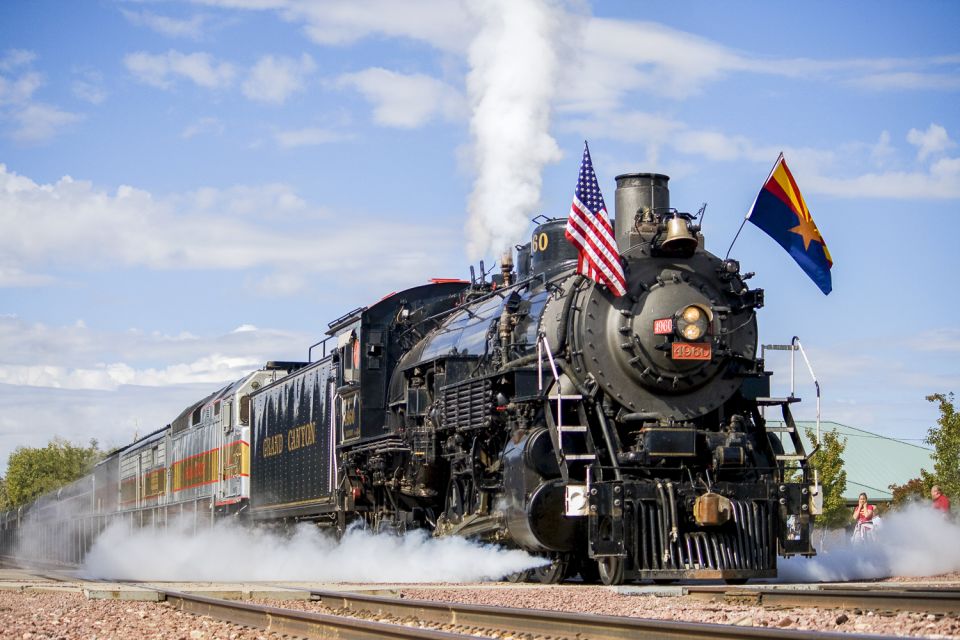
The Grand Canyon Railway runs from Williams, Arizona, 95 km (59 miles) south on Route 64, to Grand Canyon Village daily, arriving directly at the historic 1909 depot inside the park. Two hours. That's all it takes to cross high Ponderosa pine country and open Kaibab Plateau terrain in restored early-20th-century passenger cars. The locomotive trails diesel and iron through cold air that hasn't changed since the 1920s. Winter runs quieter than summer. Much quieter. The onboard entertainment, live musicians, mock train robbery reenactments, feels personal rather than performative. Less crowd, more story. Williams sits at 2,040m (6,700 ft) on Route 66. The town catches snowfall that the South Rim sometimes misses entirely. You'll arrive through snow-dusted Ponderosa forest. Then, boom, the gorge appears at track's end. A completely different experience from driving Highway 64. Plan a full day for the round trip.

Booking Tip: The railway runs daily. But December holiday dates, the week between Christmas and New Year's, sell out weeks ahead. Book at least 3 weeks ahead for late December travel. Various coach and cabin class options are available. See current pricing and availability in the booking section below.
Night Sky Stargazing

Grand Canyon National Park earned International Dark Sky Park status, and December's 14-hour nights, winter solstice darkness, team with the Kaibab Plateau's dry desert air to create the year's sharpest astronomical window. Walk to Yavapai Point or Desert View's parking area, far from the Village's glow, and the Milky Way burns naked-eye when the moon drops below the horizon. The canyon adds a dimension flat dark-sky sites can't match: that same 1,600m (1-mile) abyss framing daylight views becomes a velvet void beneath more stars than most people will ever see. Cold helps, oddly, clear, frigid air carries less moisture and dust than warm summer skies, so December clarity can beat July's. Dress for real winter: rim temps on clear December nights hit -7°C (19°F) or lower, and an hour of motionless stargazing demands serious insulation. Ranger-led astronomy programs run on selected winter evenings, weather permitting, check the schedule at the Visitor Center when you arrive. Guided private stargazing tours with telescopes are available. See current options in the booking section below.

Booking Tip: Ranger programs come free with your park ticket. But seats vanish fast, hit the Visitor Center before breakfast to lock in that evening's talk. Private guided astronomy tours? Reserve at least 1 week ahead for December dates or you'll miss the stars.

December Events & Festivals

What's happening during your visit

Throughout December
Winter Ranger Interpretive Programs

Winter flips the switch. The park's ranger-led program schedule slows to an intimate December cadence, smaller circles, longer answers. Geology talks at Yavapai Geology Museum, Native American history presentations at the Visitor Center, and ecology walks along the Rim Trail now cap at twelve instead of sixty. The conversation goes deeper. After dark, the historic district around El Tovar Hotel and Bright Angel Lodge turns into an informal hub. The Bright Angel Lodge's stone fireplace lounge, built from canyon rock in 1935, pulls rangers and visitors into unhurried exchanges the summer crush won't allow. Check the current program schedule at the Canyon View Information Plaza on arrival. Times and topics shift every week.

Packing Checklist

Bookmark this page — your progress is saved between visits

Essential Tips

Insider knowledge and common pitfalls to avoid

Insider Knowledge
From November 1 through March 1, Hermit Road reopens to private vehicles, December's sharpest edge over summer. The 12 km (7.5 mile) west rim road turns shuttle-only from April through October, forcing summer visitors into 20-minute chunks on a rigid timetable. December lets you drive the whole stretch at your own speed. At roughly the 10 km (6.2 mile) mark sits Pima Point, with an unobstructed view straight into the inner gorge. On still December mornings, the Colorado River becomes faintly audible from 900m (3,000 ft) above, a low, continuous roar that the summer shuttle schedule never gives you time to hear. Budget 2-3 hours for the full drive and return. Skip Mather Point. Yavapai Geology Museum sits 1.2 km (0.75 miles) east along the paved Rim Trail and delivers the same canyon punch with elbow room. The panorama through floor-to-ceiling windows matches Mather Point, minus the selfie scrum. Inside, geological cross-sections turn the 1.7-billion-year rock sequence into a readable story, and the heat kicks in when rim temps drop. Most tourists pivot at Mather. Add 15 minutes. You'll win every time. At 740 m (2,400 ft) the inner canyon at Phantom Ranch sits in a climate zone that feels nothing like the South Rim. December afternoons down on the Colorado River bottom hit 10-15°C (50-59°F), calm days let you strip to a light layer for lunch. Multi-day backpackers and mule riders see what rim visitors can't: desert plants shutting down, cottonwoods along Bright Angel Creek bare and yellow, great blue herons stalking the edges, the hush of a place 90-plus percent of park visitors only glimpse from 1,600 m (1 mile) up. Grandview Point and Lipan Point in December with fresh snow on the Tonto Platform, this is the angle of the canyon that the summer crowd passes without stopping to understand. Desert View Drive sometimes closes temporarily after significant winter storms. Typically for 1-4 hours while crews clear ice from the road surface. This catches visitors who set off from the Village without checking conditions. The payoff for making that 30-second check at the Canyon View Information Plaza before heading east: those views. Worth it.
Avoid These Mistakes
The upper Bright Angel Trail will kill you if you show up without traction devices. Those shaded switchbacks between the rim and the 1.5 Mile Resthouse freeze solid after cold nights, then stay icy past noon once December's sun drops low. The path looks harmless until it isn't, and "isn't" means a 1,600m (1-mile) plunge. Rangers send shoe-less hikers back daily in December. Pack microspikes from home; don't bet on the trailhead loaner bin. December at Grand Canyon? You'll hit a locked gate. Highway 67 shuts at Jacob Lake, 75 km (47 miles) before the North Rim, once snow piles up, and that happens mid-November. Visitors who've booked winter trips hoping to tick both rims pull up to the park boundary and find out the hard way. The South Rim stays open every day of the year. The North Rim does not. Two different adventures, 563 km (350 miles) of asphalt between them, and in December you get only one. Most visitors dress for the thermometer. They're wrong. The South Rim sits at 2,100m (6,900 ft). No windbreaks exist at Mather Point, Yavapai Point, or the Desert View Watchtower observation deck. Wind chill at these locations can push a 2°C (35°F) afternoon to a felt temperature of -12°C (10°F) or below. Underdressed visitors spend their time moving between warm car and cold viewpoint. They don't stand at the rim. That's a significantly diminished version of the Grand Canyon experience.

Book Experiences in Grand Canyon

Top-rated things to do in Grand Canyon this December

Explore More Activities in Grand Canyon

Didn't see anything interesting yet?

Browse Viator's full catalog of tours, day trips, food experiences, and private guides in Grand Canyon.

See All Grand Canyon Tours on Viator